Now in Beta on iOS

Recovery for your Mind, Body, & Soul

Physical therapy, cognitive exercises, and emotional support in one app, because recovery at home isn’t three separate problems. Guided by Lilly, your AI companion.

Join the Beta

Free during beta • Join our TestFlight

NeuroBloom home screen: Katie’s plan for the day with three of four exercises completed, her Recovery Garden at 1,460 points, and a tip from Lilly

Why we built this

Six years ago, my wife Katie had a hemorrhagic stroke at 32.

We left the hospital with a packet of paper instructions and a sinking feeling of “what now?” Rehab had a plan. Home didn’t. Katie didn’t need another list of exercises. She needed a companion for the part nobody prepares you for.

NeuroBloom is the app we needed and couldn’t find. That’s the whole reason it exists.

Zack Walmer

Founder, and Katie’s husband

Read the full story

800,000

people have strokes in the US every year. That’s about one every 40 seconds. Rehab ends. Recovery doesn’t. NeuroBloom is in beta, built for the part that happens at home.

Source: CDC, Stroke Facts

How it works

A day with NeuroBloom

Not another program to keep up with. Five moments in an ordinary day, and what the app does in each of them.

The NeuroBloom home screen showing today’s plan with three of four exercises completed

First thing

A plan you can actually finish

Four movements, chosen for where you are today. A short list you can finish, and see finished.

Lilly replying to a message about being too tired to exercise, suggesting rest or light movement

When it’s hard

Lilly doesn’t push

Tired days happen, and they aren’t failures. Tell Lilly you haven’t got it in you today. She’ll suggest one light movement instead, or tell you that rest is fine and mean it.

The Recovery Exercises list with three of today’s movements marked complete

The work itself

Guided, not guessed at

Every movement comes with steps and a demonstration, grouped by what it’s for. Tick it off when it’s done.

The Recovery Garden with a rose, lavender and oak tree grown from completed exercises

Over time

Progress you can see without reading a chart

Every finished exercise grows your Recovery Garden. Some days the numbers barely move. The garden still does, and after a hard month that’s something to look at.

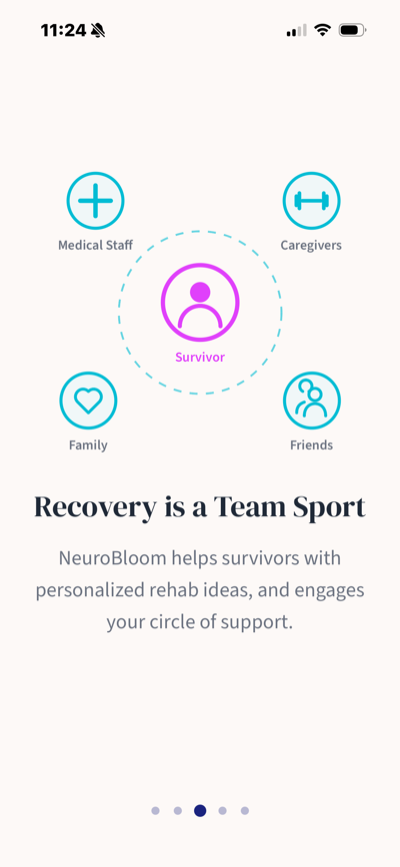
Recovery is a Team Sport: how NeuroBloom connects survivors, caregivers, medical staff, family and friends

The people around you

Nobody does this alone

Invite a partner, a daughter, a physio. They see how the week actually went and can send a nudge or a kudos. You choose who, and what they see.

The circle of care

Recovery is a team sport

Three people are in every recovery, and they each need something different from the same app.

For Survivors

  • Independence: Guided exercises you can do on your own, anytime.
  • Hope: Visualize your progress with our "Garden" that grows as you heal.
  • Lilly AI: Your always-on companion for motivation and questions.
Join as a survivor

For Caregivers

  • Coordination: A shared dashboard to track meds, appointments, and mood.
  • Peace of Mind: Know exactly how your loved one is doing, even remotely.
  • Reduced Burden: Lilly handles the daily reminders and nudges.
Join as a caregiver

For Medical Pros

  • Adherence you can see: Patients keep going between visits, and you can tell whether they did.
  • Real Data: See actual engagement metrics, not just self-reports.
  • Continuity: The work carries on between hospital and home.
Join as a clinician

Straight answers

Who’s building this, and what it is

Who’s building it

NeuroBloom is built by Zack Walmer, who spent six years in stroke recovery as a caregiver, alongside survivors, caregivers and rehab professionals who know the journey home is the hardest part.

What it isn’t

NeuroBloom is not a medical device and doesn’t diagnose or treat anything. Lilly is an AI companion, not a clinician. It supports the work your care team gives you. It never replaces them.

Your data

Your care team sees only what you invite them to see, and you can remove anyone at any time. We don’t sell your data. Read the privacy policy.

Questions

Before you join

What does it cost?
NeuroBloom is free during the beta. We haven’t set pricing yet. When we do, beta users will hear it from us first.
What do I need to join?
An iPhone and an Apple ID. The beta runs through Apple’s TestFlight app, so you’ll install that first. You get the link as soon as you sign up.
Is there an Android version?
Not yet. The beta is iOS only. Sign up anyway and tell us you’re on Android. It’s how we decide what to build next.
Does this replace my therapist or doctor?
No. NeuroBloom supports the work your care team gives you between appointments. It isn’t a medical device, it doesn’t diagnose or treat anything, and Lilly is an AI companion rather than a clinician. Always follow your care team.
Who can see my information?
Only the people you invite. You add a caregiver or clinician to your care team yourself, you choose what they can see, and you can remove them whenever you like. Details are in the privacy policy.
How rough is the beta?
Rough in places. You may hit bugs, and things will change under you. In exchange it’s free, and what you tell us genuinely shapes what gets built. If that trade sounds bad right now, waiting for the public release is a perfectly good choice.
How do I give feedback?
Reply to any email we send, or write to zack@neurobloom.io. It reaches the person building the app.

Ready to start blooming? Join the TestFlight beta. Free for early users.